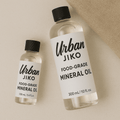


Food Grade Mineral Oil
Food Grade Mineral Oil
- Pure mineral oil
- No additives
- 300ml or 100ml
- 300ml or 100ml, stated on the bottle
- Pure oil, no wax or fragrance
- Never goes rancid
- For boards, utensils and bowls
What it's for
The boards and utensils this keeps alive. One delivery, no extra shipping.
-
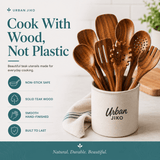 Teak Wooden Utensil Set
$160.00$79.97 -
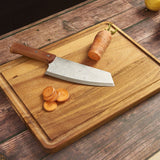 Acacia Solid Chopping Board
$110.00$54.97
Couldn't load pickup availability
Description
Description
Food Grade Mineral Oil
Restore. Protect. Preserve. Introducing Urban Jiko’s Food Grade Mineral Oil—a pure, additive-free conditioning oil designed to nourish your wooden kitchenware naturally and safely.
Our premium, 100% food‑safe mineral oil penetrates deeply into the wood, creating a hydrated, smooth finish that enhances the wood’s natural beauty while strengthening and preserving it.
Why You'll Love It
Pure & Safe – Made from 100% food‑grade mineral oil, with no additives, preservatives, or fragrances—safe for use on any surfaces that touch food.
Deep Conditioning – Penetrates deeply to help prevent drying, cracking, and splitting; leaves behind a healthy glow and revitalized grain.
Versatile Use – Ideal for cutting boards, butcher blocks, wooden utensils, bowls, serving trays, and even bamboo kitchenware.
Maintain Longevity – Perfect for new or dry wood—apply weekly for the first month; for ongoing care, reapply every 3–4 weeks or when the wood looks or feels dry.
Effortless Application – Just clean and dry the wood, rub in a small amount with a cloth, let it soak in for a few hours or overnight, then wipe away any excess—no sticky residue. Simple, Natural, Effective
Bring out the best in your wooden kitchen essentials—make every meal prep surface fresh, resilient, and beautiful again, while reducing waste and extending product life.
Which size, and how far it goes
Which size, and how far it goes
- 300ml — the one to buy if you own more than one wooden thing. Enough to treat a large board around ten times, or a whole utensil set several times over.
- 100ml — enough to bring one board or one utensil set back and keep it going for a year.
Per millilitre the 300ml is roughly half the price of the 100ml, so unless you want the small one to try, the large is the sensible buy.
What it is
What it is
Pure food-grade mineral oil. No beeswax, no carnauba, no fragrance, no drying agents — one ingredient. That matters because blended finishes leave a film that eventually goes patchy and has to be stripped; a pure oil soaks in and simply needs topping up.
It never goes rancid. This is the reason mineral oil is what wooden boards are finished with rather than olive, walnut or any other kitchen oil. Vegetable oils polymerise and turn, and a board treated with one eventually smells. Mineral oil is inert and does not.
How to use it
How to use it
Make sure the wood is clean and completely dry. Pour a little onto a cloth — more than you think — and rub it into the grain, going with it rather than across. Leave it to soak in for a few hours or overnight, then buff off whatever has not been absorbed with a dry cloth.
How often. Weekly for the first month on a new or very dry board, then whenever the colour looks pale and dry rather than deep. For most households that is a few times a year.
What it suits. Chopping boards, wooden utensils, salad bowls, butter boards, salt cellars, wooden lids — anything solid wood that touches food.


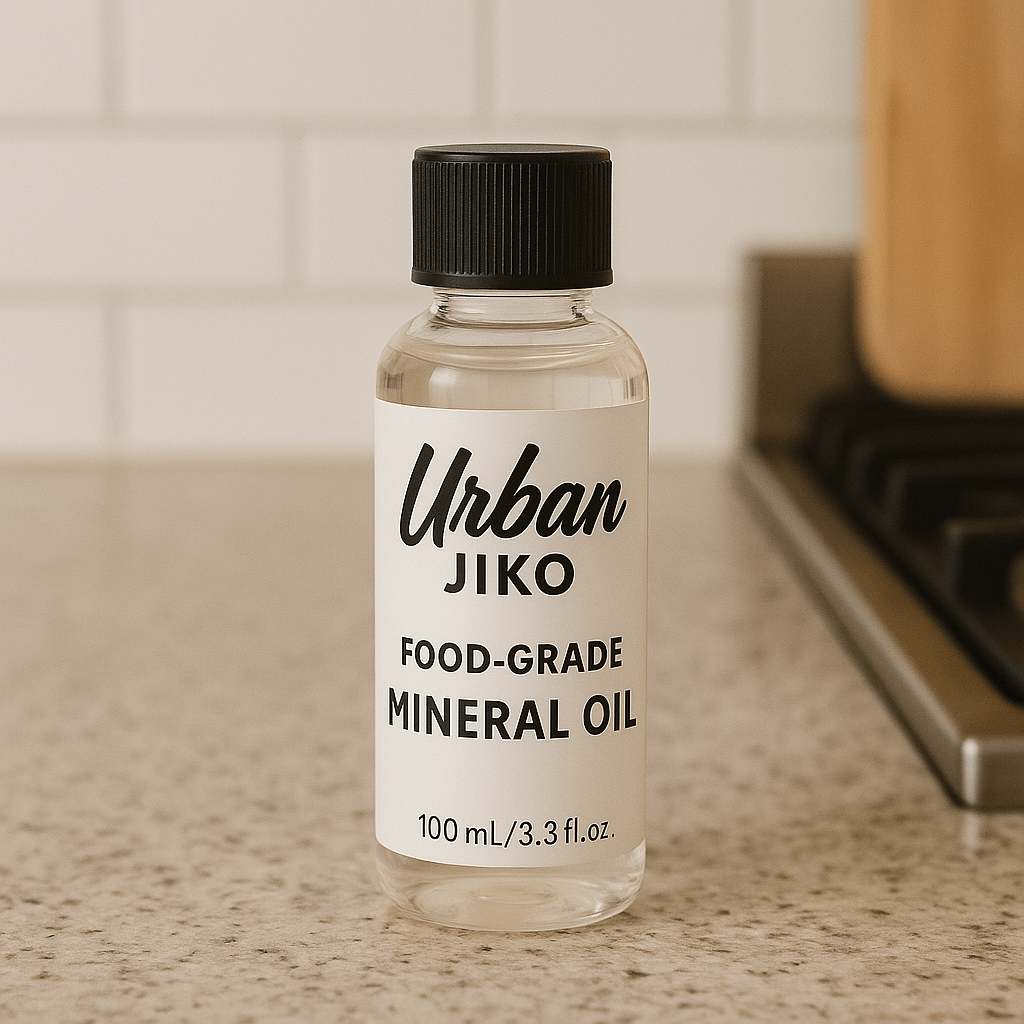
The ten minutes that saves a board.

300ml or 100ml, and the big one is half the price.
Per millilitre the 300ml costs roughly half what the 100ml does, which is the sort of thing a listing should tell you rather than leave you to work out. Buy the small one to try it on a single board; buy the large one if you own a wooden board, a utensil set and anything else made of timber, because you will use it.
- 300ml or 100ml
- 300ml is half the price per ml
- Volume printed on the bottle

It never goes rancid.
This is the whole reason wooden boards are finished with mineral oil rather than olive or vegetable oil. Kitchen oils polymerise and turn, and a board treated with one develops a smell that cannot be washed out. Mineral oil is inert. It soaks in, it feeds the grain, and it stays exactly as it was for as long as it is in there.
- Inert, never turns
- Not olive or vegetable oil
- One ingredient, nothing else

Dry wood cracks. This is what stops it.
A board that has gone pale and dry is a board on its way to splitting, because wood that has lost its oils moves with every change in humidity. Ten minutes with a cloth two or three times a year is the entire difference between a board that lasts a decade and one that does not — and it brings the colour back in the process.
- Boards, utensils, bowls, lids
- A few minutes, a few times a year
- Colour comes straight back
Questions
Frequently asked about this oil
How much oil do I get?
300ml or 100ml, whichever you choose — and the volume is printed on the bottle. The 300ml works out at roughly half the price per millilitre, so it is the better buy unless you only want to try it.
How many boards will a bottle do?
The 300ml will treat a large board about ten times over, or a full utensil set several times. The 100ml is enough to bring one board back and keep it going for a year.
Is it pure mineral oil or a blend?
Pure — one ingredient. No beeswax, no carnauba, no fragrance, no drying agents. A blend leaves a film that eventually goes patchy and has to be stripped off; a pure oil soaks in and just needs topping up.
Why not use olive oil?
Because it turns. Olive, vegetable and nut oils polymerise and go rancid, and a board treated with one develops a smell you cannot wash out. Mineral oil is inert, which is exactly why it is what wooden boards are finished with.
How do I apply it?
Clean, completely dry wood. Pour a generous amount onto a cloth, rub it in along the grain, leave it a few hours or overnight, then buff off what has not soaked in.
How often should I do it?
Weekly for the first month on a new or very dry board, then whenever the wood looks pale and dry rather than deep. A few times a year for most households.
What can I use it on?
Anything solid wood that touches food — chopping boards, utensils, salad bowls, butter boards, salt cellars, wooden lids. It is the maintenance for the whole wooden range.
What if I'm not satisfied?
Thirty days to change your mind, no hassle. If it is not right we will put it right.
Quality has a cost. Middlemen shouldn't.

- Workshop

- You

vs. the usual route
- Workshop
- Exporter
- Importer
- Brand
- Distributor
- Retailer
- You
Real customers. Real kitchens.
Brought a board back that I had written off. The colour returned completely.
Bought the 300ml after doing the maths. Obviously the better buy.
Pure oil, no wax film to go patchy. That was what I wanted.
Ten minutes twice a year and my teak set still looks new after three.
Explained why not to use olive oil. I had been doing exactly that.
Goes a long way. The 300ml has done four boards and a utensil set.
No smell at all, which is the point.
Works on everything wooden we own, including the bowls.
Keeps the whole wooden range alive. Cheapest insurance in the kitchen.